
Rate Limiting, Proxies, and CAPTCHAs: Why DIY Scraping Does Not Scale
Building your own web scraping stack seems simple at first, until rate limits, proxy bans, and CAPTCHAs bring everything to a halt. This article explains why DIY scraping fails at scale and how Crawleo removes these hidden costs for developers and AI teams.
 Khaled Hawwas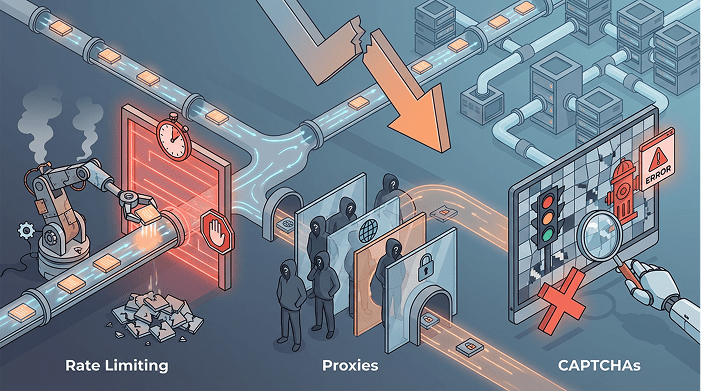
On this page
Introduction
Web scraping is often one of the first technical solutions developers reach for when they need external data. A simple script, a few HTTP requests, and the problem looks solved. In reality, scraping at scale introduces challenges that quickly turn into engineering and operational bottlenecks.
Rate limiting, proxy management, and CAPTCHAs are not edge cases. They are core defenses of the modern web. This is why many teams eventually abandon DIY scraping in favor of managed crawling APIs like Crawleo.
Rate Limiting: The First Wall You Hit
Most websites actively control how frequently they allow requests from a single source. This is known as rate limiting.
Common symptoms include:
- HTTP 429 Too Many Requests responses
- Temporary IP bans
- Silent throttling with incomplete responses
At small scale, adding delays between requests may work. At production scale, rate limiting becomes unpredictable. Different sites enforce different thresholds, and limits can change without notice.
To work around this, teams often try:
- Distributed request scheduling
- Rotating IP addresses
- Custom retry logic and backoff strategies
Each workaround adds complexity and still does not guarantee stability.
Proxies: Necessary but Hard to Manage
Once rate limits appear, proxies become unavoidable. Using proxies introduces a new set of problems:
- Finding reliable residential or datacenter proxy providers
- Detecting and replacing burned IPs
- Handling regional and geographic restrictions
- Debugging failures caused by slow or unstable proxy nodes
Proxy costs also scale with usage. As traffic grows, so does proxy spend, often without clear visibility into which requests are actually successful.
For most teams, proxy management becomes a full time operational task rather than a side detail.
CAPTCHAs: The Breaking Point
CAPTCHAs are designed to stop automated access entirely. When scraping reaches a certain volume or pattern, CAPTCHA challenges appear:
- Image and checkbox challenges
- JavaScript based bot detection
- Behavioral analysis tied to browser fingerprints
Solving CAPTCHAs programmatically is expensive and fragile. Third party CAPTCHA solving services add latency, cost, and legal uncertainty. Headless browser automation increases infrastructure requirements and still does not guarantee success.
At this stage, DIY scraping often becomes slower and more expensive than the data it produces.
Why DIY Scraping Does Not Scale
The core issue is not technical skill. It is economics and reliability.
DIY scraping requires continuous investment in:
- Infrastructure and scaling logic
- Proxy and IP rotation systems
- Anti bot detection bypasses
- Monitoring, retries, and failure recovery
As usage grows, maintenance effort grows faster than data value. This is especially problematic for AI systems that depend on consistent, real time inputs.
How Crawleo Solves These Problems
Crawleo is built specifically to remove the operational burden of scraping and crawling.
Key advantages include:
- Built in handling of rate limiting and request pacing
- Managed proxy infrastructure with geographic targeting
- Automated mitigation of common bot detection mechanisms
- Clean, AI ready output formats like Markdown and plain text
Instead of managing scraping infrastructure, developers interact with a simple API that delivers usable data.
Designed for AI and Automation Workflows
DIY scraping often returns noisy HTML that requires heavy post processing. Crawleo focuses on outputs optimized for modern use cases such as:
- Retrieval Augmented Generation pipelines
- AI agents and autonomous research tools
- Automation workflows and no code integrations
- Knowledge ingestion for LLM based systems
This reduces token usage, preprocessing logic, and downstream failures.
When Using Crawleo Makes Sense
Crawleo is a strong fit when:
- You need real time web data at scale
- Reliability matters more than one off scripts
- Your team wants predictable costs and behavior
- Data feeds power AI or production systems
For quick experiments, DIY scraping may work. For production systems, it rarely does.

